

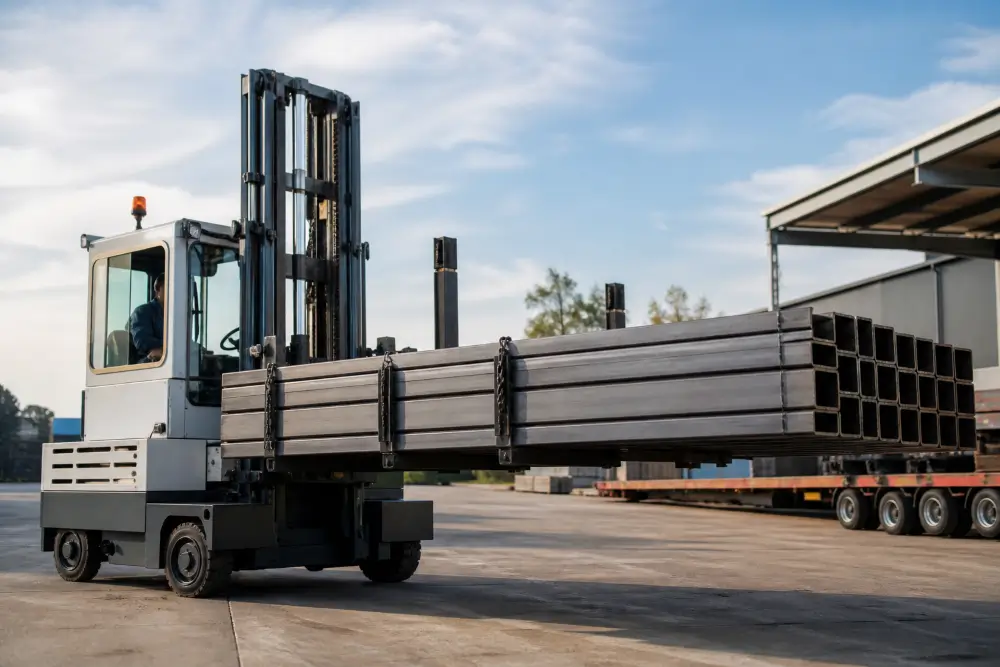
Many WA businesses still default to flatbeds, hired cranes and forklifts when they need to shift heavy or awkward freight, largely because that is what they have always used. It works, up to a point. But when sites are tight, labour is stretched and a delayed drop cascades into hours of lost productivity, the familiar choice is not always the smart one. Sideloader transport for businesses offers a genuinely different model: a truck equipped with side-mounted cranes that can lift full containers or heavy, self-contained loads on and off from ground level, without any separate lifting gear.
In fact, there are many compelling reasons why you should use a sideloader, and this article sets out exactly when that capability delivers better outcomes than conventional options, what it means in practical terms for WA construction, regional and metro operations, and how to decide quickly whether a sideloader is the right call for your next move.
What sideloader transport actually does for your freight and sites
In plain business terms, a sideloader is a truck or trailer with two cranes mounted along its sides, which lift a full shipping container or other heavy, self-contained unit directly on or off the vehicle, placing it at ground level without any additional lifting equipment on site. The whole handling cycle typically takes just two to four minutes.
The loads it suits span a useful range: 20- and 40-foot shipping containers, site sheds and temporary buildings, prefab modules, cable drums, machinery on skids, and other dense or top-heavy units that benefit from stable, multi-point lifting rather than a single hook. That level, four-point lift keeps the load steady throughout, which matters for fragile or hazardous cargo just as much as for heavy plant.
The side-access design is where the operational difference becomes obvious. The vehicle parks alongside the intended drop zone rather than needing rear access or a loading dock, so it can work in a Perth metro back lane, a crowded industrial estate or a constrained construction site where a rear-loading trailer simply would not fit. Beyond standard ground-level drops, a sideloader can also transfer containers between trailers or from rail to road, and with the right setup can stack containers to save yard space. For most businesses, though, the central value is straightforward: self-sufficient loading and unloading wherever the load needs to go.
Operational advantages of sideloader transport for businesses
The most immediate operational gain is that a single truck and a single operator complete the whole job. There is no need to coordinate a site crane, arrange a telehandler or wait for a forklift to become available before the container can come off the vehicle. The driver handles the lift, sets the load down and moves on, which at busy WA ports, construction sites and industrial depots where equipment availability is unpredictable is worth a great deal.
Turnaround speed reinforces this. With a full handling cycle of two to four minutes, a sideloader driver is not burning time waiting for other equipment or crews to get into position, which means more drops per day, less congestion at the delivery point and fewer knock-on delays to other trades or schedules.
Site access is another area where sideloaders outperform standard options. Narrow verges, residential streets, regional farm tracks and uneven ground that would stop or slow a rear-loading trailer, a large crane or a conventional forklift are all workable territory for a sideloader. Low ground pressure makes the vehicle more suitable for unprepared terrain, a genuine advantage across regional WA where ground conditions vary widely.
Handling quality matters too. The level, controlled, multi-point lift reduces swing and shock loads compared with improvised slinging or single-hook crane picks, so there is less risk of movement that can damage the load or nearby structures. Once the container is on the ground it becomes a flexible temporary storage unit, letting staff unpack at their own pace rather than racing to clear the trailer. Fewer pieces of equipment on site also means simpler set-up, less disruption to other trades and a delivery that the receiving site can absorb with minimal fuss.
Where sideloaders save real money compared with standard options
The most direct saving is equipment hire. When a sideloader handles its own loading and unloading, you can avoid booking a mobile crane or a yard forklift just to get a container on the ground. Mobile cranes carry significant minimum call-out charges, and if they are delayed or unavailable the whole delivery stalls, so eliminating that dependency removes both a direct line item and the risk attached to it.
Labour costs follow a similar logic. Because the sideloader operator manages the lift, you need fewer people on site purely for the unloading task, leaving other staff free to focus on their core work rather than stopping to receive freight. On high-labour construction sites where time is billed by the hour, that is a real saving.
Idle and waiting time is often the hidden cost that businesses underestimate. When there is no reliance on a separately booked crane or forklift, the truck does not sit burning time while gear becomes available. Demurrage charges and standing time fees add up quickly at busy container facilities, and avoiding them can materially reduce the cost of a run. More reliable turnarounds also make it easier to slot deliveries into tight windows, such as CBD sites with restricted access hours or regional runs that need to beat a weather front, improving overall route utilisation.
Damage and claims are a further cost lever. The stable, level lift of a sideloader reduces the risk of bent container corners, crushed goods or contact with adjacent structures that more improvised handling can produce. Fewer damage events means lower repair bills, fewer insurance excesses and less project disruption, all of which carry a real dollar value that rarely appears on a single invoice but accumulates across a year of freight movements.
Safety, risk and compliance: how sideloaders de-risk your deliveries
Placing containers directly on the ground removes a common falls-from-height exposure. With conventional rear-loading trailers, workers often need to climb or operate on the trailer deck to guide loads or secure cargo, whereas a sideloader eliminates that requirement entirely; the load goes from the vehicle to the ground and personnel do not need to be elevated during the process.
Side lifting also keeps people out of the fall zone. The lift is controlled by a single trained operator, and the rest of the crew can stand clear while it happens. Compare that with a crane slinging operation, where riggers need to be close to the load to attach and guide it, or a forklift approach on uneven ground where tip-over risk is genuine. The predictable lift path and stable four-point contact mean fewer variables for things to go wrong.
For regional sites or congested city locations, load stability during the lift is particularly valuable. The reduced swing and controlled set-down lower the chance of contact with powerlines, structures or other equipment nearby, which matters both for safety outcomes and for your insurance position.
From a chain-of-responsibility perspective, engaging a specialist sideloader provider that understands permitted weights, clearances and safe operating procedures helps you demonstrate that you selected appropriate equipment and competent operators for the job. That due diligence matters under the heavy vehicle chain-of-responsibility framework, where liability can extend to anyone in the supply chain who influences how a load is carried or handled. Fewer pieces of equipment on site also means fewer equipment interfaces to manage in your risk assessment and traffic management plan, simplifying the WHS documentation for high-risk sites and reducing the number of parties whose compliance you need to verify.
How to decide when a sideloader is the right call, and where to go next
A sideloader is likely the smarter choice when several conditions apply, together or individually: you are moving full containers or heavy, self-contained units; there is no site crane, usable loading dock or capable forklift already in place; access is tight or the ground is uneven; you need a fast, low-disruption drop; or you want the unit placed at ground level for temporary storage or gradual unpacking. If most of those conditions are true, the case for a sideloader is strong.
Some concrete WA scenarios illustrate how that plays out. A metro construction site in the early stages, before any tower crane is erected, regularly needs containers of materials delivered with no resident lifting gear at all. A suburban or CBD delivery through narrow streets with no rear access makes a rear-loading trailer impractical. A regional property on unsealed or uneven ground is awkward territory for a forklift but workable for a sideloader with its low ground pressure. A depot or yard that needs to double-stack containers or efficiently transfer loads between vehicles gets direct value from the stacking and transfer capability.
There are also situations where a sideloader is not the right tool. Light pallet freight going into a warehouse with functioning docks and forklifts already on site does not need one, and oversize plant that requires a dedicated low-loader and a site crane for final positioning is a different category of lift entirely. The point is not that sideloaders replace everything, but that they are often the most efficient and cost-effective solution for the container and heavy-module work that WA businesses handle regularly.
When planning a sideloader job, having the following information ready will allow a provider to confirm feasibility and pricing quickly: the container or load dimensions and weight, any site obstacles such as powerlines, trees or soft ground, the preferred set-down position, and any access time restrictions. The more specific you can be upfront, the faster a specialist can assess the job and get a quote back to you.
For businesses wanting to check capabilities and clearances, see where sideloader transport fits into their operation, or get advice on a specific upcoming move, Reef Group’s sideloader transport resource page is a practical starting point. It covers what they carry, how the service works and how to request a quote, giving you everything you need to make an informed decision before committing to a freight plan.
