

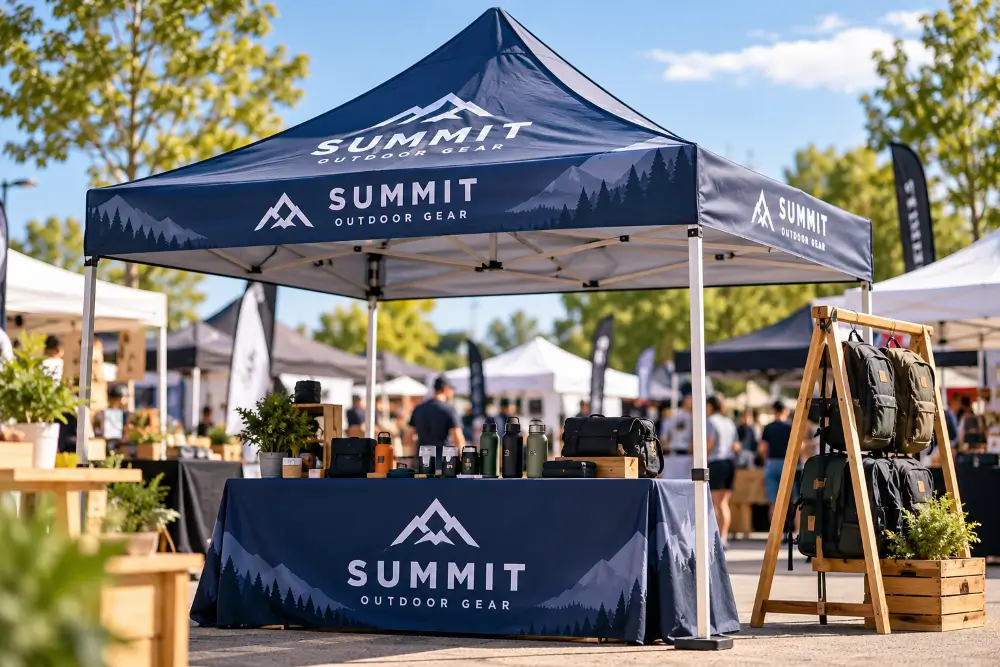
The difference between a canopy for your backyard party and one for trade shows, farmers’ markets, 3-day festivals, etc. can’t even begin to be compared. Unfortunately, many of us don’t realize that and end up getting ourselves an inexpensive pop-up canopy, which works great for Day 1 but then starts wobbling and going yellow from Day 2 onwards.
Here are some key things to keep in mind if buying a commercial canopy.
Top 7 Essential Features to Look for in a Commercial Canopy
1. Frame
Most people get this wrong! The fabric is obviously going to get attention due to it being the showy part of your canopy with your logo on it. However, the frame is what will decide if your canopy can survive a breezy Saturday.
Flimsy frames aren’t reliable, and some of them can be hard to move around. This can be an issue if you’re struggling to move them around your parking lot at 7 am. Steel frames are heavy and strong, while aluminum frames are much lighter and less likely to corrode. When looking at frames, look at the thickness of the legs. Thicker legs and joints will cost a bit more, but if they bend while at an event, then you’ll be kicking yourself!
Look out for how the corners are put together. Plastic fittings will crack. Metal (cast/machined) joints won’t crack.
2. Fabric
Most canopy tops will have a denier rating. The higher the denier, the tougher the fabric. However, it should also have a UV-resistant coating and waterproof material. A good quality commercial canopy should have both of these.
A quick test you can perform is holding the fabric up to the sun. If you can see through the weave, then you’ll experience fading and leaking much quicker.
3. Printing
If the canopy is being used for branding purposes, then the quality of the printing is key.
Ask if it uses dye sublimation. This means the ink is embedded into the fabric. Screen printing can be done on a budget; however, it will fade quicker in the sun. A high-quality custom event tent will look crisp in year 3, whereas one with poor printing will start to flake away. Obviously, everyone will remember the latter.
4. Size
10×10 canopies are standard due to fitting the standard booth sizes. However, many vendors will fit into one canopy and struggle throughout the day. Think about what you need underneath! Product displays? Table with 2 chairs and a queue? People running around?
As a general rule, go for a size slightly larger than you think you’ll need. No one has ever complained about having too much space. Almost no one!
Make sure there is enough height. 6-foot people working at your booth will be constantly ducking under the crossbars!
5. Wind Rating
Genuine commercial canopies will have a wind rating or wind testing information. If they can’t tell you how their frame will cope with wind, then you’ve found your answer.
However, this is only useful if you have anchored the canopy down. Whether you use pegs, weights, sandbags, or water barrels, make sure that you’re using what is allowed at the venue. If you have a canopy with a high wind rating but it isn’t anchored down, then it will be a large kite. Event organizers know this, so many will ask for proof. If you have the specifications, then it makes you look professional.
6. Smaller Canopies
Not every location will require a full canopy. Sidewalk promotions, small market stalls, restaurant patios, and registration desks all benefit from a custom market umbrella. These canopies offer printed branding yet take up much less space. If you pair a canopy with a canopy for larger events, then you can fit into most layouts.
7. Accessories
Walls, weights, gutter kits, and trolleys. Some of these are just extra, but some can really help! Walls will help block the wind and sun. Plus, you get extra printing space for free! Trolleys with good wheels will help your shoulders more than you’d expect after the 10th parking lot.
The extras will be obvious. Don’t bother!
End Point
A commercial canopy is an investment. The frame determines how long it lasts; the fabric determines how long it can withstand the weather; the printing determines whether it can market for you; and the anchoring determines whether it will last. By considering all 4 factors, you will have an investment that will pay for itself over several seasons. Whereas temporary canopies will be cheap, a canopy that looks professional every weekend will need to be built for the job.
